Participants' Voices
Next Stage
Double Degree
Kobe University to Fudan University
Graduate School of Economics
Ms. Marie Kunimatsu

Profile: An Education Manager at UNICEF Sudan, she studied for one year at Fudan University through the Double Degree Program in 2013, before completing her Master of Economics at the Graduate School of Economics, Kobe University in 2015.
Q1: What do you do in your current role?
In my role as Education Manager at UNICEF Sudan, I oversee large-scale education programmes for 19 million school-aged children affected by conflict. My primary responsibilities include planning and coordinating emergency education services, supporting school reopening, managing major donor-funded projects, and guiding field teams, while working closely with partners across the government, UN agencies, and NGOs.
Sudan is currently experiencing one of the world’s most severe humanitarian crises, with millions of children displaced. Under these circumstances, I manage a wide range of formal and non-formal education initiatives. This involves supporting school reopening in areas stabilizing after fighting, providing assistance to teachers and school systems, and strengthening foundational literacy and numeracy to help children catch up after long periods out of school. In locations where schools remain unsafe, we establish Safe Learning Spaces to ensure access to non-formal education in protective environments.
Working in close collaboration with international organizations and local communities, we ensure that vital education services reach children across all conflict-affected areas, including those in extremely hard-to-reach locations.
Q2: What has been the most memorable experience in your current work?
One of the most memorable experiences in my career was supporting education in a region of Sudan that had had no humanitarian access for more than a decade. Nothing about it was straightforward. It took months of conversations, listening, and slowly building trust with local authorities and communities. When we were finally able to establish learning spaces and bring basic education services to children who had never been reached before, it became an experience I will never forget. Seeing them sit in a classroom and learn for the first time was deeply moving.
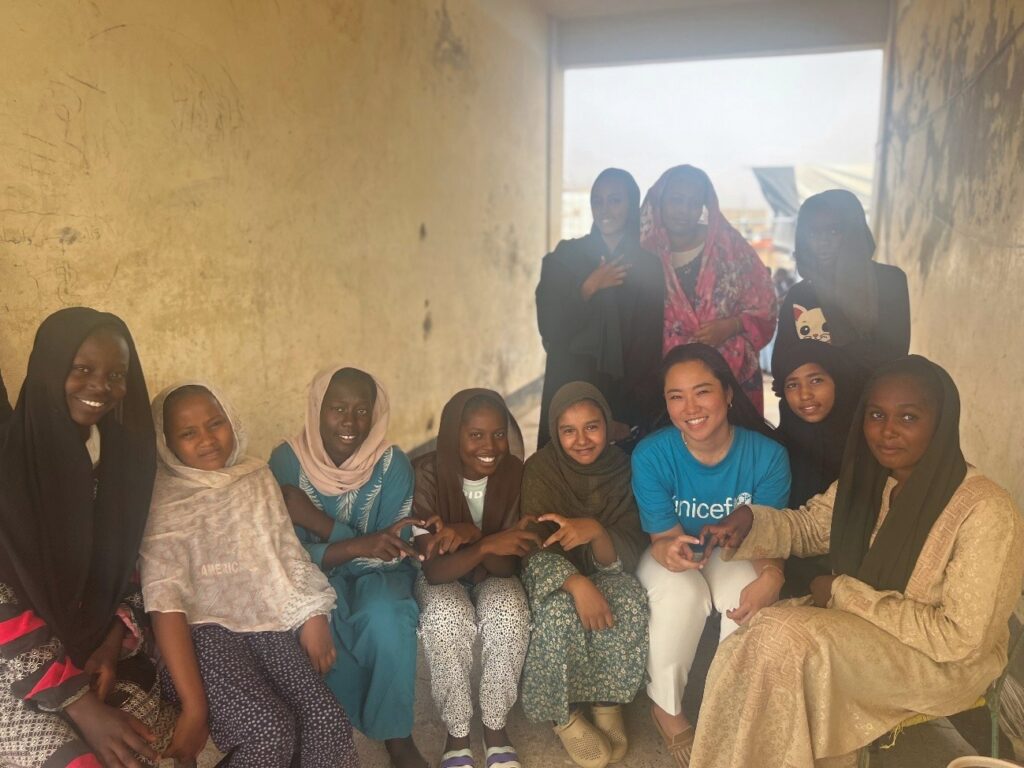
Another moment that stayed with me was meeting a group of adolescent girls who had been out of school for a year because of the conflict. After returning to learning, they began sharing their hopes for the future—one dreamed of becoming a lawyer to support children’s rights, another hoped to become a teacher, and others simply said they wanted the chance to “learn again.” Their honesty and determination, despite everything they had experienced, reminded me why creating safe learning opportunities for girls matters so much._
Q3: Why you wanted to pursue this career?
I chose this career because I believe education is one of the most powerful ways to bring stability and dignity to children’s lives, including those affected by conflict. I wanted to work in a field where I could help expand opportunities for children and support them in imagining a future beyond crisis. Working in international organizations enables me to contribute to broader system-level changes while remaining closely connected to the realities faced by communities.
Q4: What has been your most memorable experience in the CAMPUS Asia Program?
Participating in the CAMPUS Asia Program at Fudan University was a transformative experience. Our cohort included students not only from China, Korea, and Japan but also from several other countries – and that was a truly international learning environment. It wasn’t always easy to navigate, but the process made me more resilient and taught me how to collaborate in complex, multicultural spaces.
One of the most meaningful aspects of the programme was the friendships I built. Many of us later entered fields related to international development, public policy, or humanitarian work. These peers have become lifelong friends – and also professional allies who understand the challenges of working in this sector. We continue to support each other, share advice, and celebrate each other’s achievements. This network has been empowering throughout my career.
Q5: How learning from the CAMPUS Asia Programme has benefited your current work?
In my role at UNICEF, I work closely with colleagues from a wide range of countries and technical backgrounds. Conditions in the field can be unpredictable, and many situations require swift judgment as well as careful coordination. Managing a large-scale education programme in conflict-affected Sudan demands not only technical expertise, but also the ability to assess risks and work collaboratively with numerous partners to move forward under challenging circumstances.
I completed two master’s degrees: a Master of Economics at Kobe University and a Master of Public Administration at Fudan University. Studying in different academic fields helped me develop the ability to approach education support from economic, institutional, and policy perspectives. I feel that the CAMPUS Asia program naturally connected these two areas of study and provided the foundation for thinking about complex issues from multiple angles.
Also, at CAMPUS Asia, many of the courses placed strong emphasis on risk management. I learned how to analyze complex situations, determine priorities, and consider multiple perspectives when making decisions. These skills now play an important role in various aspects of my work—for example, in coordinating with government counterparts, planning interventions in hard-to-reach areas, and assessing risks related to children’s access to education.
During my student years, I also took part in several internships during long vacations. I had the opportunity to work with the Ministry of Education in Laos, FHI360, the UNESCO Institute for Capacity Building in Africa, and the United Nations Economic Commission for Africa. Experiencing these different professional environments gave me valuable insight into how projects operate within the UN system and how people collaborate across organizations -knowledge that continues to shape the way I work today. I am grateful to Professor Ogawa and other faculty members who encouraged me to take on these opportunities.
Learning in a multicultural environment, engaging in rigorous academic study, and developing the ability to analyze risks with an awareness of field realities -these aspects of the CAMPUS Asia program, strengthened further by my two master’s degrees and internship experiences, have equipped me with the capacity to navigate the complexity of real-world challenges required in my work at UNICEF.
Please share a brief message for current students and juniors.
My supervisor always encouraged us to “be proactive,” and I decided to follow my gut feeling and apply for the Campus Asia Programme. At the time, I didn’t know where it might lead, but now I’m grateful I listened to his advice. That one step opened a door to new perspectives, meaningful friendships, and ways of learning that continue to shape my work today.
As I entered this field, I realized that technical skills are important, but they’re not everything. Soft skills — how you work with others, how you approach challenges, how you understand a situation – become just as essential, and they grow gradually through real experiences. CAMPUS Asia program gave me the space and opportunity to develop these skills alongside the academic learning I was doing at the time, in my case in economics and risk management.
I’ve learned that no one needs to have everything decided from the beginning. What helped me was simply keeping in mind the general direction I wanted to move toward, and taking a moment to consider what each new challenge or opportunity might mean for me when making choices. Looking back, I feel that these small decisions, accumulated over time, eventually shaped my academic path and career. If you get the chance to join a programme like CAMPUS Asia, it may broaden your world in ways you don’t expect. And whatever path you choose, I hope it feels authentic to who you are.